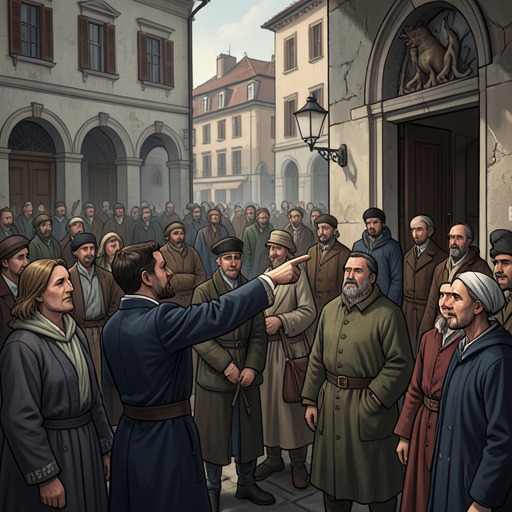
Railway strike committee
Doctor ZhivagoThe Railway strike committee organizes the coming stoppage on the Moscow railway network, where workers already expect a strike but have not settled its start date. Its importance lies partly in that delay: the committee’s hidden deliberation and the sudden public signal that follows make the strike appear, even to its participants, to begin through more than one action and more than one hand.
Background and Deliberation
That autumn, workers on the Moscow-Kazan line had gone on strike, and the Moscow-Brest line was expected to join them. The Railway strike committee had decided that a strike should take place, but its members were still arguing about the date. The railway workforce knew a stoppage was coming; only a pretext was needed to set it in motion.
The committee’s delay becomes visible through Tiverzin’s impatience. Leaving an underground shelter with Antipov, he complains that the men inside are taking too long and accuses them of playing with fire before ducking for cover. His anger is sharpened by a private obligation: Daria has typhus, and he says he ought to take her to the hospital. He expects to go to the office because wages are being paid that day, and says that, if it were not payday, he would stop the work himself rather than wait.
The Decision and the Strike
After Tiverzin leaves the shelter, the committee reaches its decision: the strike will begin that very night. Its members determine who will go where and which workers will be called out. This is practical coordination, not merely assent to a general cause; the committee distributes tasks before the stoppage becomes visible across the railway grounds.
The engine repair shop whistle sounds, at first hoarsely and then more clearly. By then, a crowd is already moving from the depot and freight yard. The boiler-room workers join after Tiverzin signals them to put down their tools. The sequence links the committee’s concealed decision to Tiverzin’s public action, but it does not make the two identical: the committee has already chosen the night and organized the calls, while his signal helps bring workers out.
The strike’s beginning is initially misrecognized by people emerging from the buildings. They ask what the signal means; some are told there is a fire and that workers are needed to put it out. Others identify the stoppage as a strike and refuse to let themselves be recruited as replacements. The committee’s planning thus meets the confusion of an unfolding event, in which the same alarm can be taken for an emergency or understood as the signal of collective withdrawal.
Tiverzin’s Role and the Committee’s Hidden Work
Tiverzin does not know that the committee decided to begin the strike after he had left the shelter with Antipov. For many years he believes that he alone stopped work and traffic on the line that night. His belief is corrected only much later, at his trial: he is charged with complicity in the strike, but not with inciting it, and learns then what the committee had decided in his absence.
That delayed disclosure separates personal recollection from the actual organization of the strike. Tiverzin’s signal remains consequential, but the committee’s prior decision gives the stoppage a broader structure than his memory allows. The committee is neither simply a background institution nor the sole visible cause: its members set the date and assign calls, while Tiverzin’s intervention helps turn that concealed plan into action on the line.
Narrative Significance
The committee’s work is represented through a gap between decision and knowledge. Its members settle the strike’s timing out of Tiverzin’s sight; he acts without knowing their choice, and the reader learns the full relation between the two actions through his later recollection of the trial. The strike therefore has no single, immediately recognized point of origin. It emerges from argument, organization, a whistle, Tiverzin’s signal, and workers interpreting what is happening around them.
The contrast between Tiverzin’s lasting assumption and the committee’s actual decision also gives collective action an unevenly remembered history. A person may experience himself as the decisive agent while a concealed group has already chosen the moment and arranged the calls. The committee’s significance lies in that conjunction: it provides the strike with deliberate coordination, while the event’s public onset remains dispersed among signals, responses, and workers leaving their posts.